Google+ SpaceTravelFoundation: space launch
Showing posts with label space launch. Show all posts

April 4, 2017

SpaceX would recover the upper-stage of their Falcon Heavy laucnher

Dear readers and followers,

Elon Musk suggested Friday that when SpaceX does its first demonstration flight of the Falcon Heavy large payload rocket later this year, it might also include an attempt to return the upper stage back to Earth. Ultimately, the goal is to make sure the upper stage on the Falcon Heavy is reusable, which is part of SpaceX’s plan to make Mars a viable target for repeat, return commercial spaceflight.


The Falcon Heavy test, which has been scheduled for some time now, is set for “late summer,” according to Musk. This is in keeping with the new 2017 timing, adjusted from late last year following delays resulting from SpaceX’s pre-flight launch pad explosion of a Falcon 9 rocket last September.
SpaceX’s Falcon Heavy is a heavy-lift rocket that would open up a whole new group of potential customers for the private launch provider. Falcon Heavy consists of three Falcon 9 cores at its center, which are made up of 27 Merlin engines, with a projected output of 5 million pounds of thrust. NASA is also preparing its own heavy launcher, the Space Launch System or SLS, with a target launch date of 2018.
Falcon Heavy will have a max cargo capacity of 119,000 pounds in terms of what it can carry to orbit, which is double the payload capacity of the current leader in operational launch craft, the Delta IV Heavy from ULA. It’ll have less capacity for actual mission launches, however, and capacity also goes down if the intent is to reuse the rocket, rather than expend it entirely in a single mission. SpaceX’s goal is to undercut both the SLS projected cost and the Delta IV Heavy actual launch bill by pricing launches at one-third the amount ULA charges.


SpaceX has successfully recovered its Falcon 9 rockets, which make up the first stage of the Falcon Heavy, on a number of occasions now, and on Thursday re-launched one of those recovered rockets for the first time ever. Now, it sounds like Musk is preparing to begin the process of successfully bringing a second stage back to earth, which in the Falcon Heavy includes a single Merlin 1D engine designed for use in a vacuum.
Recovery and reuse of both of these stages are essential to SpaceX’s Mars plan, as it eventually hopes to shuttle many tons of cargo from Earth to orbit, where they’ll be loaded on a craft destined for Mars supply missions.

Stay tuned

April 28, 2016

Successful space launch for Soyuz with Sentinel-1 satellite, Cubesats and MicroSCOPE satellite

Dear readers and followers,


The second Sentinel-1 satellite, called Sentinel-1B was launched on April 25 2016 to provide more ‘radar vision’ for Europe’s environmental Copernicus programme. The launch has been done on a Soyuz rocket from Europe’s Spaceport in Kourou, French Guiana, at 21:02 GMT (23:02 CEST), separating from the rocket’s Fregat upper stage 23 min 35 sec later.

Sentinel-1B joins its identical twin, Sentinel-1A, in orbit to deliver information for numerous services, from monitoring ice in polar seas to tracking land subsidence, and for responding to disasters such as floods.

Credit image: +European Space Agency, ESA 

ESA’s Director General Jan Woerner announed that “the launch of Sentinel-1B marks another important milestone as this is the first constellation we have realised for Copernicus,” Both satellites carry an advanced radar that images Earth’s surface through cloud and rain regardless of whether it is day or night.

Credit image: +European Space Agency, ESA 

During the launch, the satellite’s 12 m-long radar antenna and two 10 m-long solar wings were folded up to fit into the Soyuz rocket’s protective fairing. The solar wings and radar open together in a careful sequence that will take about 10 hours to complete.

Now that Sentinel-1B has been placed safely in orbit, the team of controllers at ESA’s operations centre in Germany will ensure that everything is working correctly and commission the satellite for operations.

Volker Liebig, ESA’s Director of Earth Observation Programmes, said, “We have seen some marvellous results from Sentinel-1A. Only two weeks ago, for example, it captured images of large icebergs breaking away from Antarctica’s Nansen ice shelf

In the other hand, three CubeSats took advantage of this space launch. These small satellites, each measuring just 10×10×11 cm, were developed by teams of university students through the ‘Fly Your Satellite!’ programme, run by ESA’s Education & Knowledge Management Office in close collaboration with European universities. The three CubeSats are: OUFTI-1 from the University of Liege, Belgium, e-st@r-II from the Polytechnic of Turin, Italy, and AAUSat-4 from Aalborg University, Denmark.

“Importantly, the programme is helping to educate the next generation of scientists and engineers by transferring ESA knowhow in designing, building, testing, launching and operating satellites,” said Piero Galeone, ESA’s Head of the Tertiary Education Unit. “This way we are helping to shape the space workforce of the future by enabling students to experience the full lifecycle of a real space project according to ESA’s standards.”

Credit image: +European Space Agency, ESA 

The other satellite that piggybacked a ride today is Microscope from the French space agency, CNES. MicroSCOPE (Micro-Satellite à traînée Compensée pour l'Observation du Principe d'Equivalence) is an approved CNES/ESA gravity-research minisatellite mission, put forward in 2000 by ONERA (Office National d'Etudes et de Recherches Aérospatiales), Châtillon, France, and by OCA (Observatoire de la Côte d'Azur) in Grasse, France. The mission is a collaboration between CNES, ZARM laboratory (University of Bremen), PTB (Physikalisch-Technische Bundesanstalt) of Braunschweig, Germany, OCA and ONERA.
The objective is to conduct a fundamental physics experiment, namely to test the general theory of relativity.

Credit image: +CNES 

More details about this scientific space satellite will be published in the coming days, so stay tuned.

Remember that this blog is free, but you can support us with Flattr

April 24, 2015

Ariane 5 ready for Arianespace’s upcoming heavy-lift mission

Dear reader and followers,


Arianespace has delivered another Ariane 5 to the launch zone at Europe’s Spaceport in French Guiana, positioning this workhorse heavy-lift vehicle for tomorrow’s flight with a pair of telecommunications satellites: THOR 7 and SICRAL 2.

The Ariane 5 rolled out yesterday from the Spaceport’s Final Assembly Building to the ELA-3 launch zone, where it is scheduled for liftoff during a launch window that opens on April 24th at 4:38 p.m. local time in French Guiana, or 9:38 Paris time.


Credit image: Ariane Space

For this 78th overall flight of an Ariane 5, the payload lift performance is estimated at 9,850 kg. – which includes a combined total of some 9,000 kg for the two satellites, plus the launcher’s dual-passenger dispenser system and integration hardware.

Riding as the upper passenger in Ariane 5’s payload arrangement is THOR 7, which will be released at approximately 28 minutes into the mission. The spacecraft was built by SSL (Space Systems/Loral) for Telenor Satellite Broadcasting, and will operate from an orbital position of .8 deg. West.

THOR 7 is to serve the maritime sector, delivering high-powered coverage over the North Sea, the Norwegian Sea, the Red Sea, the Baltic Sea and the Mediterranean. Also incorporated in this relay platform is a Ku-band payload for broadcast and television services in Central and Eastern Europe.

SICRAL 2 is a military telecommunications satellite developed in the framework of a turnkey contract that the Italian Defense Ministry and the French DGA armament agency (Direction Générale de l’Armement) have with Thales Alenia Space Italy; while Telespazio is responsible for the launch service. It will be deployed from Ariane 5’s lower passenger position at approximately 34 minutes after liftoff – completing the mission.

After the deployment by Ariane 5, SICRAL 2 – offering a design life of 15 years – will provide strategic and tactical telecommunications links for French and Italian military forces, as well as reserve capacity for other NATO nations.

Tomorrow’s Ariane 5 launch is designated VA222, signifying the 222nd liftoff of an Ariane-series vehicle since 1979. It also will mark Arianespace’s third flight in 2015 with a launcher from its three-member family – following the medium-lift Soyuz mission on March 27 that orbited two European Galileo FOC (Full Operational Capability) navigation satellites, and February 11’s lightweight Vega suborbital flight with Europe’s Intermediate eXperimental Vehicle (IXV) spaceplane.


Remember that this blog is free, but you can support us with Flattr


Stay tuned

January 16, 2015

Space launches from planes

Dear readers and followers,

Space launches are used to be captured in picture from the ground, but sometimes, the space launch are immortalized from planes. Enjoy these amazing pictures:


Remember that this blog is free, but you can support us with Flattr

Stay tuned

December 4, 2014

Live streaming of Orion space launch

Dear readers and followers,

Earlier this morning, the United Launch Alliance tower used to prepare the Orion spacecraft for liftoff was moved away. You can watch the rollback below: 


Mobile Service Tower rollback from NASA Orion Spacecraft on Vimeo.


The United Launch Alliance Delta IV Heavy rocket with NASA’s Orion spacecraft mounted atop is seen here at Cape Canaveral Air Force Station's Space Launch Complex 37, Florida. 

Update in pictures there:


The second stage issue and boat in the range. Delay possible, but 2 hours launch window gives flexibility. This delay is not due to technical or weather problems for launch. It's on a hold due to a boat in range of launch


- New launch time set for 7:17 a.m EST, but it has been delayed again because of wind, as shown in the picture below which show the 1-minute peak wind speed measured at 230-ft above pad 41.

- 7: 46 am EST: New T-0 of 7:55 am EST has been decided


- 7: 43 am EST: Hold hold hold again ... launch delayed

- 8: 16 am EST: New T-0 8:26 am EST, the launch will be for today


- 8: 24 am EST: HOLD AGAIN . Launch team reports the rocket's fill and drain valve did not close.


- 8:39 am EST: The technical problem seems to come from the valves. Fill-&-drain valves on 3 core boosters will be cycled open and closed to see if that solves the problem.

- 9:44 am EST: Launch of the Orion mission scrubbed for today,if the valve issue can be fixed today, NASA will try again tomorrow.


Live launch coverage of Orion begins on NASA TV at 4:30 a.m. EST with the link below: 

http://www.nasa.gov/multimedia/nasatv/#.VIBKKjGG_so

Source: +NASA


Remember that this blog is free, but you can support us with Flattr


Stay tuned

December 3, 2014

Successful launch of H-IIA with Hayabusa2 Onboard for its asteroid mission

Dear readers and followers,

H-IIA F26 (the Japan space launch vehicle) with the Asteroid Explorer Hayabusa2 onboard launched at 1:22:04 p.m. on Dec 3, 2014 (JST) from the Tanegashima Space Center, Japan. The rocket flew smoothly, and, at about approximately one hour, 47 minutes and 21 seconds after liftoff, "Hayabusa2" was separated from the space vehicle H-IIA F26.


H-IIA (H2A) is an active expendable launch system operated by Mitsubishi Heavy Industries (MHI) for the Japan Aerospace Exploration Agency ( +JAXA | 宇宙航空研究開発機構 ). The several step occurring after the liftoff has been done with success:

1. Liftoff : 0 min. 0 sec.
2. SRB-A burnout *2 : 1 min. 33 sec.
3. SRB-A jettison *3 : 1 min. 47 sec.
4. Payload fairing jettison : 4 min. 11 sec.
5. First stage main engine cutoff (MECO) : 6 min. 36 sec.
6. 1st and 2nd stages separation : 6 min. 44 sec.
7. Second stage engine lock-in (SELI1) : 6 min. 54 sec.
8. Second stage engine cutoff (SECO1) : 11 min. 20 sec.
9. Second stage engine lock-in (SELI2) : 1 hour 39 min. 26 sec.
10. Second stage engine cutoff (SECO2) : 1 hour 43 min. 31 sec.
11. Hayabusa2 separation : 1 hour 47 min. 21 sec.
12. SHINEN2 separation : 1 hour 54 min. 1 sec.
13. ARTSAT2-DESPATCH separation :1 hour 58 min. 11 sec.
14. PROCYON separation : 2 hour 2 min. 21 sec.

While Philae sleeps on the comet 67P, the spacecraft MASCOT (Mobile Asteroid Surface Scout) is planned explore asteroid and land on it. The asteroid lander developed by +DLR, German Aerospace Center, the Japan space agency +JAXA | 宇宙航空研究開発機構 and the French space agency, +CNES. 

In 2018 the Japanese Hayabusa 2 Mission will feature an asteroid landing and will, for the first time, allow for data acquisition at various points of this kind of celestial body, assisted by MASCOT , the hopping landing craft developed by the German Aerospace Center. 


The plan is to send the orbiter to its destination in 2014. Upon arrival in 2018, the spacecraft will initially remain in orbit to scout the unknown terrain. A stable, yet extremely light cover will protect the shoe box-sized lander as it falls to the asteroid’s surface. The four instruments designed to conduct in situ measurements on the asteroid are located inside the DLR landing craft: the infrared spectrometer that will analyse the surface composition magnetometer to investigate the magnetic field a wide-angle camera to record the landing site and the fine structure of the soil a radiometer that will measure surface temperatures, among other things.

Once the initial measurements are complete, MASCOT will hop to the next measurement site, providing scientists with data from different positions on asteroid on 1999 JU 3, gathered over two asteroid days and nights. During its mission, the landing craft will be monitored from the DLR Microgravity User Support Center (MUSC).

1999 JU3 is an Apollo asteroid. The asteroid was discovered in 1999 by the LINEAR project. The Apollo asteroids are a group of near-Earth asteroids named after 1862 Apollo, the first asteroid of this group which was discovered by Karl Wilhelm Reinmuth. 


Remember that this blog is free, but you can support us with Flattr

Stay tuned

October 31, 2014

Video of the failed Antares launch taken from a plane

Dear readers and followers,

Everyone saw the videos taken from the ground of the dramatic failed space launch of the Antares rocket, however, this time +Ed Sealing had the opportunity to make the video from a plane. 

Image from the video of +Ed Sealing

The video is really impressive and taken with an iPad Mini from a Cessna 177 Cardinal from an altitude of 914 meters.


Credit video: +Ed Sealing 

Stay tuned

Incident Response Team completed an initial assessment of Wallops Island

Dear readers and follower,


The Wallops Incident Response Team completed today an initial assessment of Wallops Island, Virginia, following the catastrophic failure of Orbital Science Corp.’s Antares rocket shortly after liftoff at 6:22 p.m. (local time, EDT) Tuesday, October 28th , from Pad 0A of the Mid-Atlantic Regional Spaceport at NASA’s Wallops Flight Facility in Virginia.


“I want to praise the launch team, range safety, all of our emergency responders and those who provided mutual aid and support on a highly-professional response that ensured the safety of our most important resource, our people,” announced Bill Wrobel, Wallops director. “In the coming days and weeks ahead, we'll continue to assess the damage on the island and begin the process of moving forward to restore our space launch capabilities. There's no doubt in my mind that we will rebound stronger than ever.”

The initial assessment is a cursory look; it will take many more weeks to further understand and analyze the full extent of the effects of the event. A number of support buildings in the immediate area have broken windows and imploded doors. A sounding rocket launcher adjacent to the pad, and buildings nearest the pad, suffered the most severe damage. At Pad 0A the initial assessment showed damage to the transporter erector launcher and lightning suppression rods, as well as debris around the pad.

The Wallops environmental team also is conducting assessments at the site. Preliminary observations are that the environmental effects of the launch failure were largely contained within the southern third of Wallops Island, in the area immediately adjacent to the pad. Immediately after the incident, the Wallops’ industrial hygienist collected air samples at the Wallops mainland area, the Highway 175 causeway, and on Chincoteague Island. No hazardous substances were detected at the sampled locations. Additional air, soil and water samples will be collected from the incident area as well as at control sites for comparative analysis.

The Coast Guard and Virginia Marine Resources Commission reported today they have not observed any obvious signs of water pollution, such as oil sheens. Furthermore, initial assessments have not revealed any obvious impacts to fish or wildlife resources. The Incident Response Team continues to monitor and assess.

Credit image: +NASA Wallops 

Based on initial sweeps conducted by an Orbital safety team, it appears a significant amount of debris remains on the site and it is likely substantial hardware evidence will be available to aid in determining root cause of the Antares launch failure. Some of the Cygnus cargo has also been found and will be retrieved as soon as they have clearance to do so to see if any survived intact. 
After up close visual inspections by the safety team, it still appears the launch site itself avoided major damage. There is some evidence of damage to piping that runs between the fuel and commodity storage vessels and the launch mount, but no evidence of significant damage to either the storage vessels or launch mount. Detailed evaluations by MARS and their engineering team will occur in the next couple of days. An Orbital-led team has begun cataloging and documenting the location of all pieces of debris over the next several days after which the debris will be relocated to storage bays on the island for further evaluation.

Telemetry data has been released to Orbital and their engineers presented a very quick look assessment to the Accident Investigation Board at the end of the day. It appears the Antares vehicle had a nominal pre-launch and launch sequence with no issues noted. All systems appeared to be performing nominally until approximately T+15 seconds at which point the failure occurred. 
Evidence suggests the failure initiated in the first stage after which the vehicle lost its propulsive capability and fell back to the ground impacting near, but not on, the launch pad. Prior to impacting the ground, the rocket’s Flight Termination System was engaged by the designated official in the Wallops Range Control Center.

Source: +Orbital Sciences and Technologies, Inc. and +NASA


Remember that this blog is free, but you can support us with Flattr


Stay tuned

October 29, 2014

Antares rocket failed during its launch to ISS and exploded

Dear readers and followers,


The +Orbital Sciences and Technologies, Inc.'s Antares rocket lifted off to start its third resupply mission to the International Space Station, but suffered a catastrophic anomaly shortly after liftoff at 6:22 p.m. EDT. The Orbital Sciences team is executing its contingency procedures, securing the site and data, including all telemetry from the Antares launch vehicle and Cygnus spacecraft. Before launch the Orbital team was not tracking any issues.No injuries have been reported, and Orbital reports that all personnel around the Wallops Flight Facility launch site have been accounted for.


Credit video: +NASA Wallops 


"Launching rockets is an incredibly difficult undertaking, and we learn from each success and each setback. Today's launch attempt will not deter us from our work to expand our already successful capability to launch cargo from American shores to the International Space Station.” said William Gerstenmaier, associate administrator of +NASA's Human Exploration and Operations Directorate, regarding today's Orbital Sciences Corp's launch mishap.


Damage was contained to the hazard area, but there may have been a scattering of debris. Public safety is our number one priority. If people find debris in the vicinity of the launch tonight, please stay away & call the Incident Response Team at 757-824-1295.

Source: +Orbital Sciences and Technologies, Inc. and +NASA


Remember that this blog is free, but you can support us with Flattr


Stay tuned

October 28, 2014

Antares rocket launch from NASA's Wallops could be seen in Washington D.C. this evening

Dear readers and followers,


[Update]: Orbital Sciences is set to try a second attempt to launch its Antares rocket and Cygnus cargo ship today at 6:22 p.m. EDT the launch window is about 10 minutes long. Public viewing of the launch will be available at the NASA Visitor Center at Wallops, as well as at the Chincoteague National Wildlife Refuge and Assateague Island National Seashore.

The launch of the Antares rocket from NASA’s Wallops Flight Facility in Virginia may be visible in D.C. this evening, October 28th 2014. Coverage of the mission begins at noon and will be live-streamed here.


The Orbital Sciences’ rocket will carry Orbital’s Cygnus cargo spacecraft. Its payload is about 5,000 25000 kg of supplies and experiments, dedicated for the International Space Station. The spce launch is scheduled at 6:45 p.m. Today, October 28th. If weather permitting, people from DC should be able to see the rocket approximately 180 seconds after launch, as presented in the following picture. 


Remember that this blog is free, but you can support us with Flattr

Stay tuned

September 24, 2014

SpaceX will get its own space launch site

Dear reader and followers,


Monday morning, the September 22th, SpaceX broke ground at the site near Boca Chica beach in Cameron County, Texas, where it plans to build a commercial rocket launch pad. As SpaceX founder Elon Musk lifted a shovel of dirt, his ultimate goal of developing technology to enable trips to Mars took a step forward. “This feels great. It feels like the future,” Musk said. Governor Rick Perry and other dignitaries were also at this event. "This announcement represents a huge step forward for our state and continues our nation's proud legacy of scientific advancement," Perry said. "It builds upon our pioneer heritage, our tradition of thinking bigger, dreaming bolder, and daring to do the impossible. SpaceX is the latest in a long line of forward-thinking companies that have made Texas home, and I couldn't be prouder to help break ground on this revolutionary new facility." The Boca Chica site will be the world’s first commercial orbital space port.


Musk said he wants the company’s new commercial orbital rocket launch site to be operational as soon as possible. That means the paved launch site near the end of U.S. Highway 4 at Boca Chica should be complete in about nine months, with the first rocket launch taking place as early as late 2016. The rocket launch site will be located about three miles north of the Mexican border and about five miles south of Port Isabel and South Padre Island.


SpaceX intends to build a vertical launch area and control center to support 12 commercial launches per year. The vehicles launched include the Falcon 9, Falcon Heavy and smaller reusable, suborbital launch vehicles. Musk revealed that he expects “thousands of launches.” Furthermore, “when we start doing commercial crew activities, I would expect us to launch a crew from here,” he said. Moreover, he added "What’s important is to have a truly commercial launch site, just like we have commercial airports. Every sort of structure has its primary focus and I think it’s important that the world have a truly commercial orbital spaceport,”.

Rep. Filemon Vela, who introduced Musk and Perry, predicted that the “benefit from an educational and economic standpoint that SpaceX will bring to this region is something that many of us never dreamed of.” In addition, Perry said that “Over the course of the last 13, almost 14 years, we have looked for major projects of which we can make a really big impact on South Texas,” “I noticed the sign behind me that says ‘pavement ends in 1,000 feet.’ But the future of South Texas takes off right behind me. And that’s what today’s really all about.”

Perry also announced an investment of $9 million from the Texas Emerging Technology Fund and The University of Texas System to establish STARGATE to develop and support commercial phased-array technology for satellite and space vehicle communication. The city of Brownsville, through the Greater Brownsville Incentives Corporation will contribute $500,000 to the project.


Monday's groundbreaking is the result of years of cooperation between Texas and SpaceX. The idea for a commercial spaceport in Texas was first discussed on a TexasOne trip to California in 2011. Since then, Gov. Perry has met with Elon Musk and written letters to the Federal Aviation Administration (FAA) to help secure clearance for the facility. Also, several members of the Governor's staff have appeared in front of the FAA to help bring the facility to Texas.

Source: Space X


Remember that this blog is free, but you can support us with Flattr


Stay tuned

July 24, 2014

Successful liftoff of the Progress 56 cargo and docking to ISS soon

Dear readers and followers,


last night, the ISS Progress 56 has lifted off (3:44 a.m. local time on July 24 in Baikonur), from the Baikonur Cosmodrome in Kazakhstan. The spacecraft is loaded with about 2600 kg of food, fuel and supplies for the six-person Expedition 40 crew in ISS.

Credit image: Roscosmos


Astronaut Reid Wiseman tweeted this photo of the International Space Station orbiting Earth saying, "We have an open parking spot up here. First come first served! Progress launches tonight." 


Credit image: Reid Wiseman


Stay tuned for the docking

July 23, 2014

Tonight Progress 56 cargo will takeoff from Baikonur to ISS

Dear readers and followers,

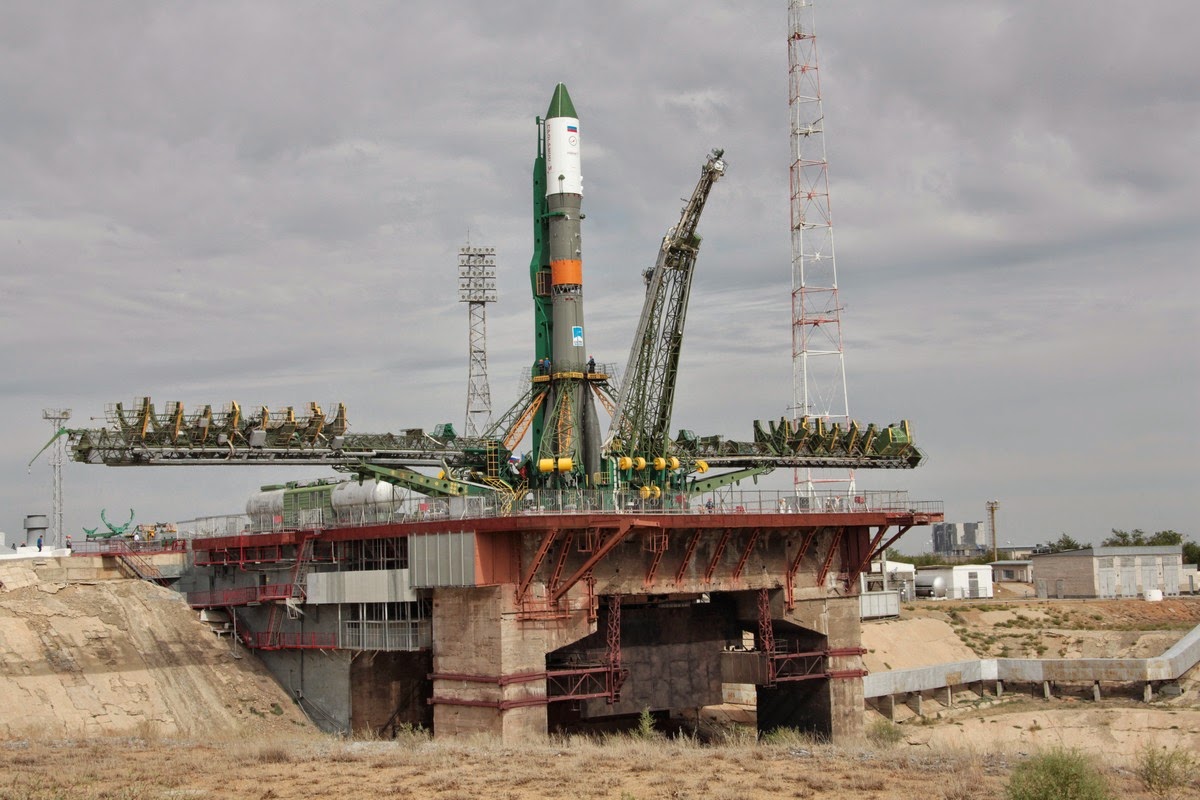
Yesterday, the International Space Station (ISS) Progress 56 cargo craft rolled out on a railcar to the launch pad at the Baikonur Cosmodrome in Kazakhstan for final preparations for liftoff. The Progress, loaded with about 2600 kg of food, fuel and supplies for the six-person Expedition 40 crew, will launch Today at 5:44 p.m. EDT (3:44 a.m. Thursday, Baikonur time) on a 4 orbit, and 6 hours fast track rendezvous to dock with the station’s Pirs docking compartment at 11:30 p.m.


Credit image: Roscosmos

Pirs was vacated late Monday with the undocking of the ISS Progress 55 cargo craft, which separated from the station at 5:44 p.m. Progress 55 is now a safe distance from the complex for a series of engineering tests prior to being sent to a destructive re-entry over the Pacific Ocean on July 31st.


At Kourou, French Guiana, technicians are completing tests on the attitude control system in the third stage of the Arianespace Ariane 5 rocket that will launch the European Space Agency’s fifth and final Automated Transfer Vehicle (ATV-5). Arianespace and ESA are working toward establishing a firm launch date, with launch likely to take place early next week. The ATV-5, named the “Georges Lemaitre” in honor of the Belgian physicist and astronomer, is slated to dock to Zvezda on August 12th. 


Live NASA Television coverage of the Progress launch begins at 5:30 p.m. and returns at 11 p.m. for docking coverage. 
You could follow the live video here on SpaceTravelfoundation's blog

Stay tuned

Source

May 26, 2014

Student built rocket took off from the Bonneville salt flats, Utah

Credit image: NASA - Dusty hood 


A student-built rocket took off from the brilliant white hardpan of the Bonneville Salt Flats in Tooele County, Utah, May 17th 2014 during the Student Launch rocketry competition. 
Sixteen teams, comprised of some 250 student participants from 15 states, launched rockets of their own design, complete with three working science and engineering payloads apiece, cheered on by approximately 500 spectators.

NASA Student Launch is an annual education event, designed to inspire young people to pursue studies and careers in the science, technology, engineering or mathematics field. The event is organized by NASA's Marshall Space Flight Center in Huntsville, Alabama, and sponsored by ATK Aerospace Group of Magna, Utah. The grand-prize-winning school team will be named by NASA and ATK in late May. 

April 30, 2014

Successful space launch performed by the ESA rocket Vega

Dear readers and followers,

yesterday night, April 30th, the space launcher of the +European Space Agency, ESA called Vega, succeeded its Arianespace’s fourth mission so far in 2014, putting the company on track to perform a total of 12 launches from Europe’s Spaceport during the year. The lift-off occurred at the space center in Kourou, French Guiana, at 10:35 pm local time.

Credit: ArianeSpace

This launch leads to orbit an 800 kg Earth observation spacecraft, called KazEOSat-1 which will provide many images to the Republic of Kazakhstan with a complete range of civil applications; for instance, the monitoring of natural and agricultural resources, provision of mapping data, and support for rescue operations in the event of a natural disaster.


Stay tuned
March 27, 2014

The SpaceX-3 resupply mission to ISS postponed again

Dear readers and followers,


today, NASA and SpaceX have been confirmed that Sunday's launch (March 30th) of its third contracted resupply mission to the International Station (ISS) has been postponed due to a range asset issue. 


Credit: SpaceX 


The spacecraft should resupply ISS but also deploy the next generation module for data communication using a laser, called OPALS for Optical Payload for Laser Science. More information including a new target launch date will be posted as it becomes available. 

Stay tuned.


Find the french version of the article there

March 26, 2014

Successful launch of the space mission Expedition 39 in Soyuz TMA-12M to ISS

Dear readers and followers,

yesterday night, three new crew members, the Russian Cosmonauts Aleksandr Skvortsov and Oleg Artemyev and the NASA astronaut Steven R. Swanson blasted off into Space tonight  at 21:17 UTC in the TMA-12M spacecraft onboard the space rocket Soyuz-FG from the Russian Baikonur cosmodrome in Kazakhstan. 


Credit: Rt.com


The new crew, will dock to the International Space Station 6 hours after their launch and join the current crew members already onboard. Their mission on ISS will take around 6 months. Find below the video of the take-off.

 
Credit: NASA 


Update: Due to a failure, the spacecraft has to change the docking process to ISS. The spacecraft will use the previous standard process for the docking which needs to make 34 orbits of Earth. Stay tuned


Stay tuned

March 24, 2014

59th straight success for Ariane 5 from Kourou

Dear followers and readers,


last Saturday, March 22th 2014, the European space rocket, Ariane 5, performed with success a flawless launch from Europe’s spaceport at Kourou, French guiana. The space rocket orbited two telecommunications satellites, ASTRA 5B and Amazonas 4A. The flight was the European launcher’s 59th straight success since 2003. 


Credit image: CNES 

Stay tuned

March 16, 2014

Successful launch of Proton-M rocket with Russian AT1 and AT2 communication satellites

Dear readers and followers,


2 days ago, the space rocket, Proton-M was ready on its launch pad at Baikonur, Kazakhstan. The payload was two satellites of communication, built for the Russian Satellite Communications Company Express AT1 and Express AT2.

Credit: Russian Space Agency Roscosmos

If you missed the successfully, enjoy this video proposed from our Event: The rocket carried two communications satellites into orbit. 
AT1 satellite will be positioned at 56 degrees East with 32 Ku-Band transponders to cover Russia. In an other hand, the AT2 satellite will be positioned at 140 degrees.

Credit: SpaceVidNet

Stay tuned