Google+ SpaceTravelFoundation: ISS
Showing posts with label ISS. Show all posts

August 19, 2015

Launch of the Japanese supply spaceship to ISS today

Dear readers and followers,


Japan will launch its robotic HTV-5 cargo vessel toward the International Space Station on Wednesday morning, August 19th at 7:50 a.m. EDT (1150 GMT). You can watch the liftoff live in the window below, courtesy of NASA TV. Coverage begins at 7 a.m. EDT (1100 GMT). If all goes according to plan, HTV-5 will arrive at the space station next Monday morning, August 24th 2015.


The HTV is one of four robotic spacecraft that currently resupply the space station, along with Russia's Progress freighter and the Dragon and Cygnus vehicles, which are built by American companies SpaceX and Orbital ATK, respectively. The HTV, Progress and Cygnus are designed to burn up in Earth's atmosphere at the end of their cargo missions, while Dragon makes a parachute-aided splashdown in the ocean when its time in space is done.

Remember that this blog is free, but you can support us with Flattr


Stay tuned

April 13, 2015

SpaceX just released some gorgeous 4K rocket launch footage

Dear readers and followers,

As if watching rockets going to space wasn't already awesome, +SpaceX  just released a two-minute supercut of 4K footage of its Falcon 9 rocket launches. It's got some slow-motion footage, some HDR-style footage, and lots of different angles of a vehicle that is capable of producing a million pounds of thrust. All of it is beautiful, even if it's accompanied by an unnecessarily loud techno track that covers up the thrilling sound of a rocket taking off.


  Credit video: +SpaceX

Coincidentally, SpaceX has another Falcon 9 launch scheduled for today. After the rocket helps deliver cargo to the +International Space Station, the company will once again attempt to land its reusable Falcon 9 on an autonomous drone ship at sea; something it has unsuccessfully tried twice. No pressure. 
Credit image: +SpaceX 

SpaceX intends to build a vertical launch area and control center to support 12 commercial launches per year.

Remember that this blog is free, but you can support us with Flattr

Stay tuned

October 24, 2014

Astronauts complete spacewalk to fix power regulator on ISS

Dear readers and followers,


Two NASA astronauts wrapped up a spacewalk of around 6 hours last wednesday October 15th to replace a failed power regulator. Flight Engineers Reid Wiseman and Barry Wilmore also relocated equipment on the ISS’s exterior to begin setting the stage for a reconfiguration of the orbiting complex to accommodate future commercial crew vehicles.

Credit image: +NASA TV


Wiseman, the lead spacewalker for Wednesday’s excursion, and Wilmore switched their suits to battery power at 8:16 a.m. EDT, signaling the start of the spacewalk (EVA-28). The spacewalk timeline was set up to ensure that Wiseman and Wilmore could remove the faulty sequential shunt unit (SSU) during a night pass when the arrays were not generating power. A few moments before passing into orbital darkness, the spacewalkers were treated to a spectacular view of Egypt, the Nile river and the Red Sea passing by 418 km below. "I see Cairo, can't quite make out the pyramids, though," Wiseman observed.

For the highest priority task of the spacewalk, Wiseman and Wilmore exited from the Quest airlock and translated out to the starboard side of the station’s integrated truss structure. There they replaced a failed power regulator known as a sequential shunt unit, which failed in May. The unit regulates power from the 3A solar array. The station has since operated normally on seven of its eight power channels, but replacing the unit provides the station team with more flexibility and redundancy in managing the primary power system and assures enough power for all the planned science. 

Timing was a factor for the replacement of the sequential shunt unit. The spacewalkers needed to remove the failed suitcase-sized unit and install its replacement while the station passed through the Earth’s shadow and electricity was not being generated by the solar array.

Working in darkness at the far right side of the station's solar power truss, at the base of the channel 3A solar array, Wiseman was initially unable to drive open a bolt holding the faulty SSU in place. 


Using a ratchet wrench and a bit of elbow grease, he successfully "broke torque" on the bolt and pulled the shorted SSU out of its mounting bracket. He then ran into problems bolting down the replacement. 

The remainder of the spacewalk focused on moving equipment installed on the port side of the station’s truss in preparation for the relocation of the Leonardo Permanent Multipurpose Module, or PMM, currently expected to take place next summer. The relocation of the PMM and the installation of international docking adapters scheduled to be delivered to the complex in 2015 will configure the station for future commercial crew vehicles and provide an additional berthing port for commercial cargo spacecraft.

Wiseman and Wilmore removed an external TV camera from the bottom of the P1 truss segment. Since that camera had lost its zoom capability, the spacewalkers replaced it on the top of P1 with a new camera.

The astronauts then detached an articulating portable foot restraint and tool stanchion from P1 and moved it inward to the centerpiece of the station’s truss structure, the S0 truss, to get it out of the way for the relocation of Leonardo.

Finally, the Wireless Video System External Transceiver Assembly, or WETA, which receives all the video signals from spacewalking crew members, was transferred from the P1 truss to the top of the Harmony node.

Wednesday’s spacewalk was the 183rd in support of station assembly and maintenance. This was the first spacewalk for Wilmore. Wiseman, who joined Flight Engineer Alexander Gerst of the European Space Agency for a 6-hour, 13-minute spacewalk on Oct. 7, completed his second spacewalk.

The year's seventh and final planned spacewalk is scheduled for Oct. 22 when station commander Maxim Suraev and Alexander Samokutyaev plan to jettison no-longer-needed gear and carry out a detailed photo survey of the Russian segment's exterior.

Source: NASA


Remember that this blog is free, but you can support us with Flattr


Stay tuned

September 26, 2014

Soyuz TMA-14M arrives safely at ISS despite solar array issue

Dear readers and followers,


Expedition 41, the current human increment aboard ISS, has expanded from three to six members, with last night’s safe arrival of Soyuz TMA-14M and its crew of Russian cosmonauts Aleksandr Samokutyayev and Yelena Serova, together with U.S. astronaut Barry Wilmore. 
“That little red streak, hidden behind the Dragon solar array is the Soyuz launching.” A remarkable image of the Soyuz TMA-14M ascent, captured by the astronaut Reid Wiseman.


Credit image: NASA

The trio launched from Baikonur Cosmodrome in Kazakhstan, Friday, September 26th (local time) (4:25 p.m. EDT Thursday, September 25th), embarking on a six-hour, four-orbit “fast rendezvous” profile to dock with the ISS at 8:11 a.m. Baikonur time Friday (10:11 p.m. EDT Thursday). However, all did not go entirely to plan, following the failure of one of Soyuz TMA-14M’s electricity-generating solar arrays to deploy properly.
The Soyuz TMA-14M crew Barry Wilmore, Aleksandr Samokutyayev and Yelena Serova will spend 168 days in space, forming the second half of Expedition 41 and the core of Expedition 42. 


Credit image: NASA

Source: NASA


Remember that this blog is free, but you can support us with Flattr

Stay tuned

September 18, 2014

Boeing and SpaceX share $6.8 billion in NASA space taxi program

Dear readers and followers,


NASA has awarded Boeing Co. a contract worth as much as $4.2 billion and rival Space Exploration Technologies Corp. a separate pact valued at up to $2.6 billion to develop, test and fly space taxis to carry U.S. astronauts into orbit. Reflecting NASA and White House policy goals, NASA opted for two contractors to spur competition, cut overall technical risk and hopefully keep a lid on prices.

The American built rockets and spacecraft would replace the Russian systems that currently provide the only access to the international space station. The space taxi is slated to transport its first astronaut to the orbiting laboratory by 2017.

Credit image: NASA

Last Tuesday, the NASA's long-awaited announcement marks a milestone for commercial space ventures, partly because both companies will own and operate the equipment while experiencing significantly less day-to-day federal oversight than previous manned space programs. The final value of the contracts, which likely will run past the end of the decade, depends on each of the contractors meeting specified timetables and obtaining NASA certification of their rockets and capsules for safety and reliability. Assuming the companies win those approvals, the contracts will cover as many as a dozen missions overall to shuttle astronauts and limited amounts of cargo to and from the space station.

NASA chief Charles Bolden said the awards set the stage for "the most ambitious and exciting chapter in the history of NASA and human space flight."

If the programs are successful, NASA officials believe some of the hardware eventually could be used to offer rides to space tourists. Other technology could be adapted in separate NASA efforts to develop a deep-space rocket and more-capable capsules intended to take astronauts to Mars in coming decades.

Even if NASA's plans work out, lack of international support may end up creating a new problem: the space station, or at least parts of it, could be closed as early as the middle of the next decade if various countries cut off financial support. That would leave the nascent space-taxi program looking for new destinations. For now, though, Mr. Bolden told reporters the contracts fulfill President Barack Obama's pledge to end NASA's dependence on Russia and return to using U.S.-built boosters and spacecraft to achieve orbit. The last U.S. space shuttle, which fulfilled that role, was mothballed three years ago.

Boeing's larger share of the project, which had been expected, stems partly from the higher operating costs and larger overhead it has built up over decades as a NASA contractor, government and independent space experts said. But, according to these experts, Boeing's award also reflects the higher score it garnered in some of NASA's technical rankings. Boeing's proposed technology met all of the agency's design review requirements, the experts said, while the system proposed by SpaceX, as the Southern California company is known, fell short in some areas.

NASA officials emphasized that the size of the awards underscores SpaceX's reputation as a nimble, low-cost supplier. Founded by former Web entrepreneur Elon Musk, SpaceX has grown rapidly and proven itself as a reliable shipper of cargo to the space station. The manned capsule it plans to use to carry astronauts is an upgraded version of its Dragon cargo capsule, already in use.

In previous commercial development efforts, NASA ended up awarding SpaceX basically the same amount as it did the company's chief rivals. In those instances, the gap amounted to between 3% and 10% less for SpaceX. This time, the difference was close to 25% of the total.

In a statement, Boeing stressed its work for NASA stretching back to the dawn of the space age. "Boeing has been part of every American human-space-flight program, and we're honored that NASA has chosen us to continue that legacy," said John Elbon, general manager of the Chicago-based company's space exploration unit.

Prior to the announcement at the Kennedy Space Center, NASA faced conflicting pressures from the White House and senior House Republicans. From the time the Obama administration shook up NASA's bureaucracy by proposing commercial space taxis, the agency has been keen to maintain competition. But over the years, congressional leaders have crafted legislative language and otherwise urged Mr. Bolden and his top managers to pick just one contractor for this phase of the effort, to avoid redundant spending.

In the end, NASA opted for competition but devised a series of reviews and procedures enabling it to withhold funds from either contractor if agency officials determined progress was flagging.

Sierra Nevada Corp., the third company vying for an award, didn't get a contract despite some initial support inside and outside NASA for its design. The company proposed a winged vehicle, resembling a conventional aircraft, that would launch vertically atop an Atlas V rocket but return by landing on a runway. Such a spacecraft would have "long-term reusability" to significantly reduce operating costs, according to George Torres, a former industry official and author of books on space. "That's why the arguments were so vociferous."

Once NASA decided to award Boeing the bulk of the funds, according to Mr. Torres, support for Sierra Nevada dropped dramatically because both companies envisioned using the Atlas V rocket. Under all circumstances, according to Mr. Torres and others, NASA wanted two different rockets in the mix.

But throughout the news conference, and in the comments of some lawmakers reacting to the awards, much of the emphasis was on NASA's plans to go beyond low-Earth orbit and ultimately to other planets. Robert Cabana, director of the Kennedy Space Center, described the new industry-government partnerships being forged as the "first step from planet earth to going on to Mars someday."

In the same vein, Mr. Bolden devoted a large portion of his remarks to discussing future launches and tests of NASA's Orion capsule, designed to explore the solar system beyond the space station. But unlike the commercially driven contracts for space taxis, Orion and the boosters that are intended to blast it into space are being developed by NASA under more-traditional contracts mandating closer agency oversight. Boeing has a major role in that effort.NASA has awarded Boeing Co. a contract worth as much as $4.2 billion and rival Space Exploration Technologies Corp. a separate pact valued at up to $2.6 billion to develop, test and fly space taxis to carry U.S. astronauts into orbit.

Source: NASA


Remember that this blog is free, but you can support us with Flattr


Stay tuned

September 9, 2014

Cubsats inadvertently released from ISS

Dear readers and followers,


few days ago, September 4th, two more of Planet Lab’s shoebox-sized Earth imaging satellites launched them selves from aboard the International Space Station (ISS), the latest in a series of technical mysteries involving a commercially owned CubeSat deployer located outside Japan’s Kibo laboratory module.

Credit image: NASA

Station commander Steve Swanson was storing some blood samples in one of the station’s freezers Friday morning when he noticed that the doors on NanoRack’s cubesat deployer were open, announced +NASA . Flight controllers at the Johnson Space Center in Houston determined that two CubeSats had been inadvertently released. “No crew members or ground controllers saw the deployment. They reviewed all the camera footage and there was no views of it there either,” said NASA mission commentator Pat Ryan..

The satellites, owned by San Francisco-based Planet Labs, are part of a planned 100-member network designed to collect images of the entire Earth every 24 hours. So far, 12 of 32 CubeSats delivered to the space station aboard a Cygnus cargo ship in July have been deployed, including four launched inadvertently, said NanoRacks spokeswoman Abby Dickes. In addition to the two Planet Labs satellites launched Thursday night, two more of the company’s satellites were released accidentally August 23th, a NASA status report shows.

Credit image: NASA

The latest inadvertent deployment followed unsuccessful attempts Wednesday night to return NanoRack’s CubeSat dispenser to service. Troubleshooting efforts included Jiggling, the small robotic arm holding the dispense in an attempt to get its doors to open, Ryan added.
Flight control teams are assessing whether to bring the deployer back inside the station or to try to release the remaining CubeSats still awaiting launch.

Think that this blog is free, but you can support us with Flattr


Stay tuned

September 5, 2014

ISS's astronaut point of view

Dear readers and followers,


This week, the +NASA astronaut Reid Wiseman from the Expedition 40 tweeted this photo from the International Space Station: "My favorite views from #space – just past #sunrise over the ocean,".


Credit image: NASA/ +Gregory Reid Wiseman

The Expedition 40 crew has been busy aboard the Space Station, recently performing health checks and humanoid robot upgrades. In the same time, a trio of orbital residents is packing up gear as they prepare to come back to home in less than two weeks. 
Commander Steve Swanson powered down and stowed Robonaut 2 after wrapping up its mobility upgrades this week. He installed new legs on the humanoid robot including external and internal gear as well as cables. This sets the stage for more upgrades in the fall before Robonaut takes its first steps as an assistant crew member. 
Robonaut was designed to enhance crew productivity and safety while also aiding people on Earth with physical disabilities.


Think that this blog is free, but you can support us with Flattr


Stay tuned

September 2, 2014

Russian spacecraft Foton-M4 lands successfully but all geckos lost

Dear readers and followers,


Yesterday, September 1st the, troubled satellite with live geckos and other scientific experiments onboard landed in Southern Russia, according to the Russian space agency, Roskosmos. 


However all geckos were found dead after the capsule had been opened. They must be bead because of cold, annonced the Russian space agency. The touchdown of the Foton-M4 spacecraft occurred at 13:18 Moscow Summer Time. The mission of Foton-M4 thus lasted 44 days instead of 60 days, which it was expected to fly at the time of the launch.


Credit images: Russian Space Agency

The agency's press-release also claimed that an average altitude of the satellite's orbit had been 575 kilometers, exceeding that of the International Space Station, ISS. This "piece of information" was likely copied from a pre-launch announcement, because, in reality, the orbit-correction engine onboard Foton-M4 had failed to deliver the spacecraft to its planned orbit shortly after its liftoff on July 19.

However, July 24th, Russia’s space agency has re-established communication with its Foton-M4 satellite in Earth’s low orbit, three days after losing contact.


Think that this blog is free, but you can support us with Flattr

Stay tuned

July 23, 2014

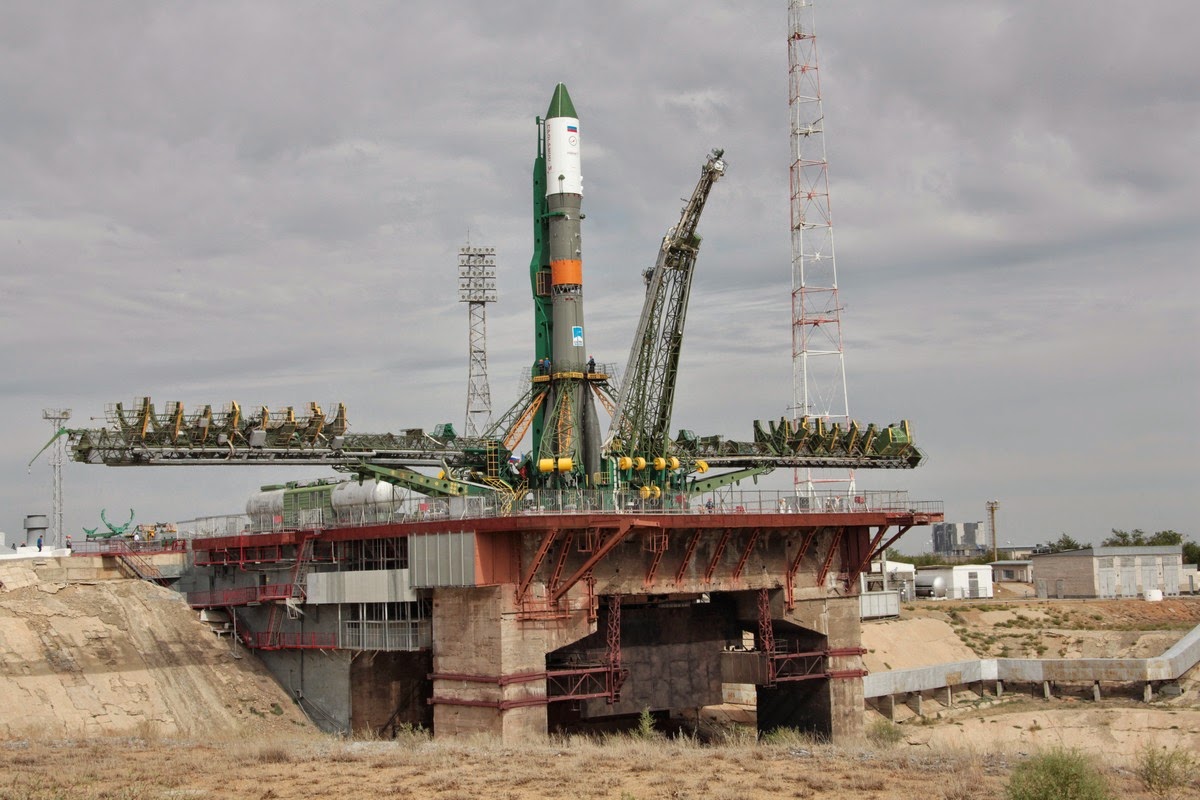
Tonight Progress 56 cargo will takeoff from Baikonur to ISS

Dear readers and followers,

Yesterday, the International Space Station (ISS) Progress 56 cargo craft rolled out on a railcar to the launch pad at the Baikonur Cosmodrome in Kazakhstan for final preparations for liftoff. The Progress, loaded with about 2600 kg of food, fuel and supplies for the six-person Expedition 40 crew, will launch Today at 5:44 p.m. EDT (3:44 a.m. Thursday, Baikonur time) on a 4 orbit, and 6 hours fast track rendezvous to dock with the station’s Pirs docking compartment at 11:30 p.m.


Credit image: Roscosmos

Pirs was vacated late Monday with the undocking of the ISS Progress 55 cargo craft, which separated from the station at 5:44 p.m. Progress 55 is now a safe distance from the complex for a series of engineering tests prior to being sent to a destructive re-entry over the Pacific Ocean on July 31st.


At Kourou, French Guiana, technicians are completing tests on the attitude control system in the third stage of the Arianespace Ariane 5 rocket that will launch the European Space Agency’s fifth and final Automated Transfer Vehicle (ATV-5). Arianespace and ESA are working toward establishing a firm launch date, with launch likely to take place early next week. The ATV-5, named the “Georges Lemaitre” in honor of the Belgian physicist and astronomer, is slated to dock to Zvezda on August 12th. 


Live NASA Television coverage of the Progress launch begins at 5:30 p.m. and returns at 11 p.m. for docking coverage. 
You could follow the live video here on SpaceTravelfoundation's blog

Stay tuned

Source

April 24, 2014

Space Selfie outside the International Space Station

Dear readers and followers,


Yesterday, during a spacewalk outside ISS, an astronaut snapped this Space Selfie! It's been said that it's difficult to get a good selfie while wearing a spacesuit. Astronauts Steve Swanson and Rick Mastracchio completed a short spacewalk to replace a failed Multiplexer/Demultiplexer (MDM) back up computer. The backup computer failed April 11th after a routine health check by the Mission Control team in Houston said NASA.  

Credit: +NASA 

March 28, 2014

Successful docking of Soyuz TMA-12M with ISS after engine trouble delays arrival

Dear readers and followers,


Wednesday March 26th, we reported that the Soyuz spacecraft which liftoff from Baikonur had to change the docking procedure to the International Space Station (ISS) due to a engine failure during its space launch.
Today, the Russian spacecraft arrived and docked with ISS using the previous standard procedure which needed 2 additional days of flight (34 Earth orbit).


Credit: Euronews 

The new crew considering 3 astronauts, the Russian Cosmonauts Aleksandr Skvortsov and Oleg Artemyev and the NASA astronaut Steven R. Swanson will spend 6 months in the international Space Station.


Stay tuned

March 27, 2014

The SpaceX-3 resupply mission to ISS postponed again

Dear readers and followers,


today, NASA and SpaceX have been confirmed that Sunday's launch (March 30th) of its third contracted resupply mission to the International Station (ISS) has been postponed due to a range asset issue. 


Credit: SpaceX 


The spacecraft should resupply ISS but also deploy the next generation module for data communication using a laser, called OPALS for Optical Payload for Laser Science. More information including a new target launch date will be posted as it becomes available. 

Stay tuned.


Find the french version of the article there

March 26, 2014

Successful launch of the space mission Expedition 39 in Soyuz TMA-12M to ISS

Dear readers and followers,

yesterday night, three new crew members, the Russian Cosmonauts Aleksandr Skvortsov and Oleg Artemyev and the NASA astronaut Steven R. Swanson blasted off into Space tonight  at 21:17 UTC in the TMA-12M spacecraft onboard the space rocket Soyuz-FG from the Russian Baikonur cosmodrome in Kazakhstan. 


Credit: Rt.com


The new crew, will dock to the International Space Station 6 hours after their launch and join the current crew members already onboard. Their mission on ISS will take around 6 months. Find below the video of the take-off.

 
Credit: NASA 


Update: Due to a failure, the spacecraft has to change the docking process to ISS. The spacecraft will use the previous standard process for the docking which needs to make 34 orbits of Earth. Stay tuned


Stay tuned

March 14, 2014

ISS data communication boosted by the laser OPALS

Dear followers and readers,


The bandwidth speed of the communications between the International Space Station and Earth is a real bottleneck for the scientific experiments. But NASA decided to fix this problem. The slowness of capturing data from ISS is about to go into serious overdrive with a new laser communication experiment set which will be launch to ISS this weekend. The experiment gear is called OPALS for Optical Payload for Laser Science


OPALS transfers the video data from ISS to the ground receiver at JPL's Optical Communications Telescope Laboratory (OCTL) in Wrightwood, California. As the ISS travels across the sky, a laser beacon is transmitted from the ground telescope to the payload on ISS and tracked. The main existing deep space missions send back 200k to 400k bits of information per second. OPALS will send information by laser beam rather than radio wave, demonstrating a speed of up to 50 megabits per second. Future deep space optical communication systems should reach up to one gigabit per second.
The OPALS module will be sent up to the space station aboard the cargo Dragon from the private company Space X. Its launch is planned next Sunday, March 16th.


Credit: NASA 

Stay tuned for the space launch of OPALS module

[Update] The Dragon launch was postponed to March 30. Stay tuned 

February 25, 2014

Be careful: Powerful X4.9-class solar flare recorded by SDO

Dear readers,

This night, a powerful X4.9-class solar flare has been recorded by NASA . This solar flare is the most intense flare of 2014 so far, and one of the most intense of the current solar cycle. Solar flare are really critical, specially for the spacecrafts orbiting Earth. Few weeks ago, the Orb-1 mission of the Antares rocket delayed due to high space radiation environment induced by a high class solar flare. Fortunately, the solar flare was not Earth directed.
The NASA's +SDO | Solar Dynamics Observatory recorded the extreme ultraviolet flash. After a solar flare during the next 3 days, all space partners are used to be very mindful in order to monitor the behavior of their spacecraft and anticipate some possible failures. Moreover, the ISS is used to be reoriented with the aim to protect its critical modules and the crew.


Stay tuned

February 10, 2014

Progress M-22M docks with ISS 6 hours after its launch

Dear followers,


last Wednesday, February 5, the Progress M-22M spacecraft was launched by a Soyuz-U rocket from the Baikonur Cosmodrome in Kazakhstan at 4:23pm UTC. The Russian Progress M-22M, has successfully docked to ISS just 6 hours after launching from Baikonur. 
The space launch happened Less than 24 hours since its Progress M-20M cargo craft undocked from the International Space Station (ISS), following six months in residence.

Credit: +Roscosmos press service

The craft is full of cargo and supplies for the 6 membered Expedition 38 crew. Docking occurred at 22:22 UTC. With around 750 flights, the Soyuz-U is the most-flown orbital launch system ever developed.
Live the docking to the International Space Station in video :

January 12, 2014

Orbital Sciences' Cygnus cargo was berthed and installed with success to ISS

Dear followers,

after its successful lift-off from Earth 3 days ago, the Antares rocket developed by Orbital Sciences released its payload and the Cygnus was berthed and installed with success to the International Science Station. 


Credit image : Orbital Sciences


The module will remain for around one month while the crew of the space station transfers the 1.5 tons of provisions and experiments delivered by the private capsule, Cygnus. Enjoy the video:


Credit : +NASA 

January 10, 2014

Successful lift-off of the Antares rocket carrying equipments for ISS

Dear followers,

After a decrease of the radiation level which delayed the liftoff this week, the space launch  of the Antares rocket was performed. If you missed the Orb1 rocket launch to the ISS yesterday, enjoy this video 

Credit: +NASA