Google+ SpaceTravelFoundation: Roscosmos
Showing posts with label Roscosmos. Show all posts

September 2, 2014

Russian spacecraft Foton-M4 lands successfully but all geckos lost

Dear readers and followers,


Yesterday, September 1st the, troubled satellite with live geckos and other scientific experiments onboard landed in Southern Russia, according to the Russian space agency, Roskosmos. 


However all geckos were found dead after the capsule had been opened. They must be bead because of cold, annonced the Russian space agency. The touchdown of the Foton-M4 spacecraft occurred at 13:18 Moscow Summer Time. The mission of Foton-M4 thus lasted 44 days instead of 60 days, which it was expected to fly at the time of the launch.


Credit images: Russian Space Agency

The agency's press-release also claimed that an average altitude of the satellite's orbit had been 575 kilometers, exceeding that of the International Space Station, ISS. This "piece of information" was likely copied from a pre-launch announcement, because, in reality, the orbit-correction engine onboard Foton-M4 had failed to deliver the spacecraft to its planned orbit shortly after its liftoff on July 19.

However, July 24th, Russia’s space agency has re-established communication with its Foton-M4 satellite in Earth’s low orbit, three days after losing contact.


Think that this blog is free, but you can support us with Flattr

Stay tuned

July 28, 2014

Gecko sex satellite back online as Russia restores contact

Dear readers and followers,


Russia’s space agency has re-established communication with its Foton-M4 satellite in Earth’s low orbit, three days after losing contact. The robotic spacecraft contains geckos participating in experiments on how space conditions impact reproduction. Foton-M4 will be following its current orbit until Monday, while scientists discuss whether their experiments require the original trajectory, which is further from Earth, and engineers try to analyze what may have led to the communication failure. The two main versions considered by Roscosmos are mechanical damage through contact with space debris, and an internal fault in the equipment.

“We have conducted several communication sessions, and the link is stable,” said Roscosmos chief Oleg Ostapenko. 


Credit image: Oleg Voloshin


The satellite, the latest in a series that commenced in 2002, is meant to return to Earth in a controlled manner two months after its launch with Soyuz from Baikonur cosmodrome exactly a week ago. 

Credit image: Roscosmos


If, upon its return, it is discovered that the Foton-M4 was damaged by space debris, it will raise concern at the increasing pollution of the atmosphere. There are an estimated 22,000 man-made objects 10 centimeters or larger in orbit – big enough to penetrate the outer covering of the International Space Station ISS.


Contact me if you have any specific questions or to correct some typo error in the articles. 

You can support us with Flattr
Stay tuned

July 24, 2014

Russia Loses Control of Orbiting Experiment Module

Dear readers and followers,

Russia’s Roscosmos space agency on July 24 said it had lost control of the Photon-M4 unmanned life- and materials-sciences experiment module launched July 19 but that the 6,840-kilogram module appeared otherwise to be operating normally.

Credit image: Roscosmos


Roscosmos said Photon-M4 was designed to operate autonomously for extended periods and that, for the moment, the many on-board experiments are continuing to function as designed.

Photon-M4, launched aboard a Soyuz rocket from Russia’s Baikonur Cosmodrome in Kazakhstan, is in a 575-kilometer circular orbit inclined at 64.9 degrees relative to the equator. The latest in a series of Bion and Photon capsules, Photon-M4 is designed to operate for about two months before separating from its service module and reentering the atmosphere to be retrieved for experiment analysis.

Roscosmos said ground operators lost control of Photon-M4 after only a few orbits. Their primary objective now, the agency said, is to restore command-and-control links with the spacecraft.

Stay tuned

July 23, 2014

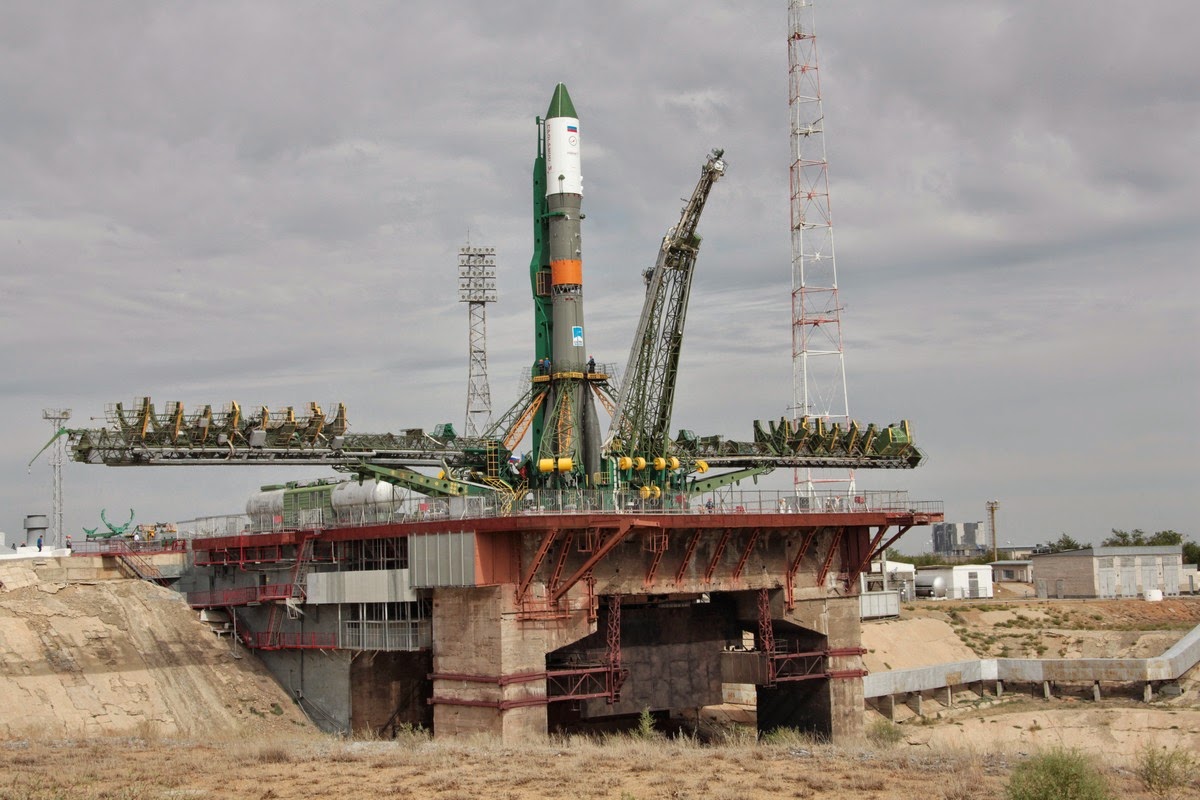
Tonight Progress 56 cargo will takeoff from Baikonur to ISS

Dear readers and followers,

Yesterday, the International Space Station (ISS) Progress 56 cargo craft rolled out on a railcar to the launch pad at the Baikonur Cosmodrome in Kazakhstan for final preparations for liftoff. The Progress, loaded with about 2600 kg of food, fuel and supplies for the six-person Expedition 40 crew, will launch Today at 5:44 p.m. EDT (3:44 a.m. Thursday, Baikonur time) on a 4 orbit, and 6 hours fast track rendezvous to dock with the station’s Pirs docking compartment at 11:30 p.m.


Credit image: Roscosmos

Pirs was vacated late Monday with the undocking of the ISS Progress 55 cargo craft, which separated from the station at 5:44 p.m. Progress 55 is now a safe distance from the complex for a series of engineering tests prior to being sent to a destructive re-entry over the Pacific Ocean on July 31st.


At Kourou, French Guiana, technicians are completing tests on the attitude control system in the third stage of the Arianespace Ariane 5 rocket that will launch the European Space Agency’s fifth and final Automated Transfer Vehicle (ATV-5). Arianespace and ESA are working toward establishing a firm launch date, with launch likely to take place early next week. The ATV-5, named the “Georges Lemaitre” in honor of the Belgian physicist and astronomer, is slated to dock to Zvezda on August 12th. 


Live NASA Television coverage of the Progress launch begins at 5:30 p.m. and returns at 11 p.m. for docking coverage. 
You could follow the live video here on SpaceTravelfoundation's blog

Stay tuned

Source

November 7, 2013

Successful take-off of Soyuz from Baikonur [with video]

Dear followers,


yesterday, the Soyuz was ready on the pad for its launch. This morning the Russian spacecraft took-off with success from the Baikonur cosmodrome in Kazakhstan.

Credits: REUTERS / Shamil Zhumatov

Actually, the Russian space agency, Roscosmos successfully launched the Soyuz spacecraft TMA-11M bound for the International Space Station. The crew comprises the Japanese Koichi Wakata, the American +Rick Mastracchio and the Russian Mikhail Tyurin. The trio are carrying a replica of the Olympic torch for the 2014 Winter Olympic Games that are set to take place in Sotchi, Russia.
"It's just an outstanding day and a spectacular launch" said William Gerstenmaier, the NASA's associate administrator for human exploration and operation.

Enjoy, the video of the take-off (with French commentary) : the launch starts at 14:30 in the video